Project
Two portals for two opposite audiences: people who have yet to choose a university, and people who have worked inside one for years. Underneath, the same kit.
University of Pavia: two portals, one evolving kit
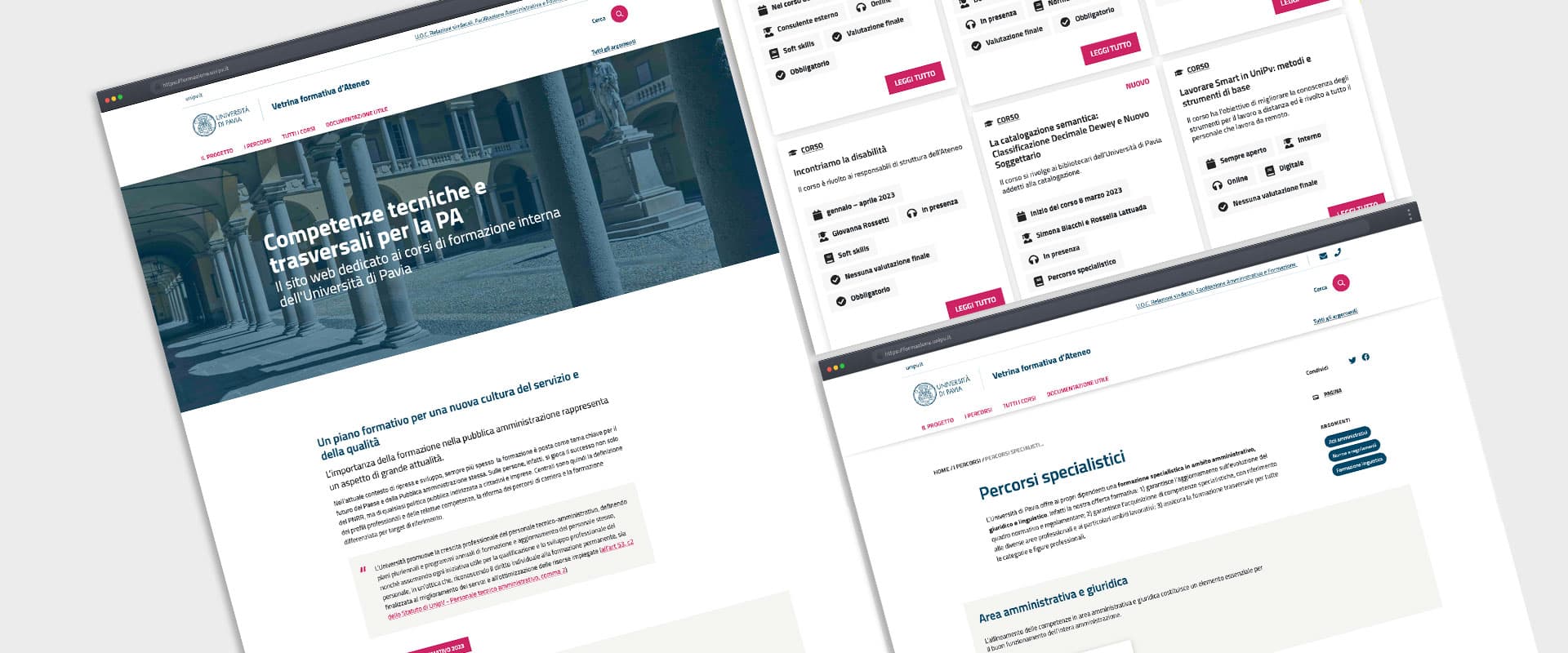
- Client
- University of Pavia
- Area
- Identity, Development
- Year
- 2021 - 2024
In the early months of 2021 the University of Pavia commissioned Dinamo to rebuild its digital student guidance service, together with the C.OR. Centre. The aim was to improve the quality of the service for students arriving, studying and leaving. The work moved in three directions: analysis and strategy, content production and social marketing, and the design and development of the site.
Two years later the same university came back with a very different request: a portal for the internal training of university staff. The audience is the opposite, the method is the same.
Two separate web projects born from the same kit, applied to different worlds within the same university.
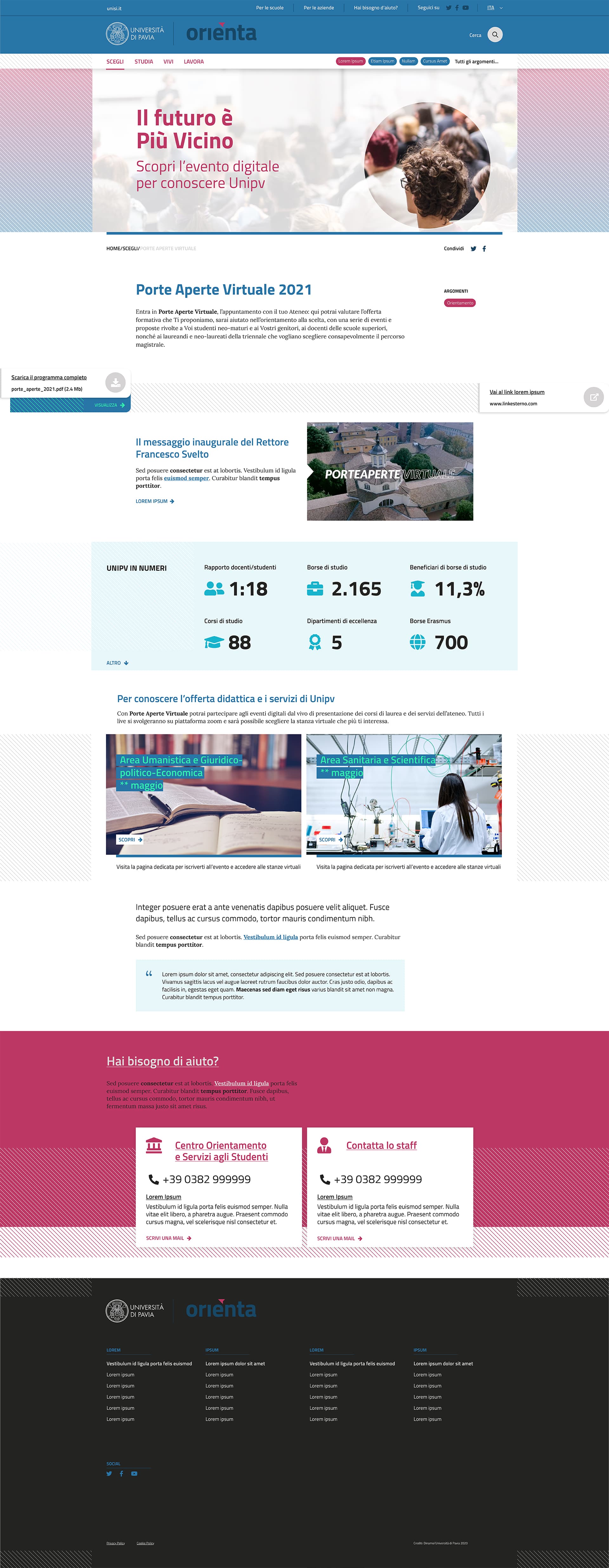
The work on orienta.unipv.it begins with the service, not with the site. The preliminary analysis ran through focus groups with internal staff and surveys of secondary school students, bringing into focus the university's value proposition for people who have yet to enrol. From there came guidelines for a new body of content, texts and visuals that communicate both the service and the university's identity.
The site is the heart of the project, but it comes later. Orienta is a single point of access, mobile first, with an internal search engine that lets each person tailor their own path. It follows the student's route: choosing a university, the map of the teaching offer from degrees to curricula and examinations, life outside the lecture rooms with halls, libraries, canteens and tutoring, and finally guidance on leaving and support for graduates moving towards work. From any point you can contact the staff responsible for the service directly.
The design starts from what we had already built for the University of Siena in 2020. The stated aim was to use the skeleton of the Siena guidance platform, adapt it and develop it.
The kit has two branches. The UI kit, a set of graphic templates, visual elements and navigation systems: at Siena it was an extension of the Designers Italia kits, at Pavia it becomes a further development of the Siena kit. The Dev kit, the software components: Docker, RESTful APIs, a Drupal CMS, a page builder, an Angular frontend.
The method is inherited too. Target persona profiling, definition of the user journey, card sorting, interface solutions: everything validated at Siena is repeated and extended at Pavia. A public project should not start from scratch every time.
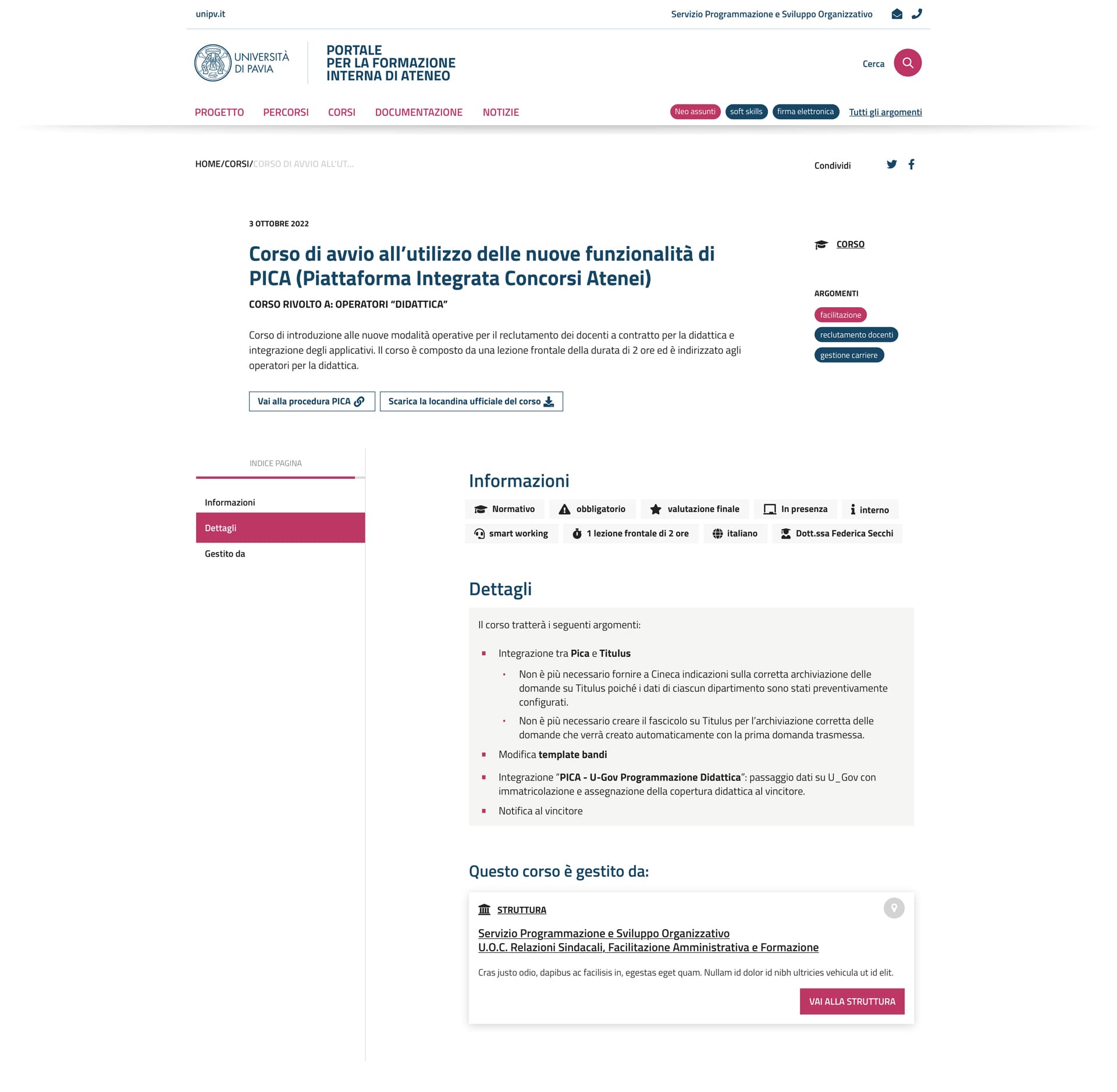
The effectiveness of an information architecture for public administration is measured by how far it has been designed around people's real needs. The content is organised on two attributes.
The content types, models of content each with its own characteristics and taxonomies. The kit defines a standard set repeatable across public universities: document, funding call, service, page, structure, staff, person, news, event, external link, topic, course.
The topics, a vocabulary of terms relevant to the sector. Every tag is a marker applicable to any piece of content, and lets people move across the site horizontally, beyond the boundaries of the content types.
Above it all, the page builder. Dozens of components the editorial team uses to compose pages like a box of bricks, each with its own styles and functions, all consistent with the design of the system.
The UniPv internal training portal: the same kit, the opposite audience
In 2023 the university came back with a different problem. Internal staff training has become a strategic factor for public administration: it builds the skills needed to face digital transformation and new regulation. But information about the courses was hard to find for the people working in that university.
formazione.unipv.it is built on the same kit, with the content types adapted to the context: course, document, event, news, structure, person, funding call, editorial page. The same Designers Italia standards, the same REST interoperability, the same mobile first approach, the same search engine.
The audience is the opposite of Orienta's. Not an eighteen-year-old student who has to choose, but a public employee who has to keep up to date. The kit carries both, because the structure is the same and only what has to change changes.
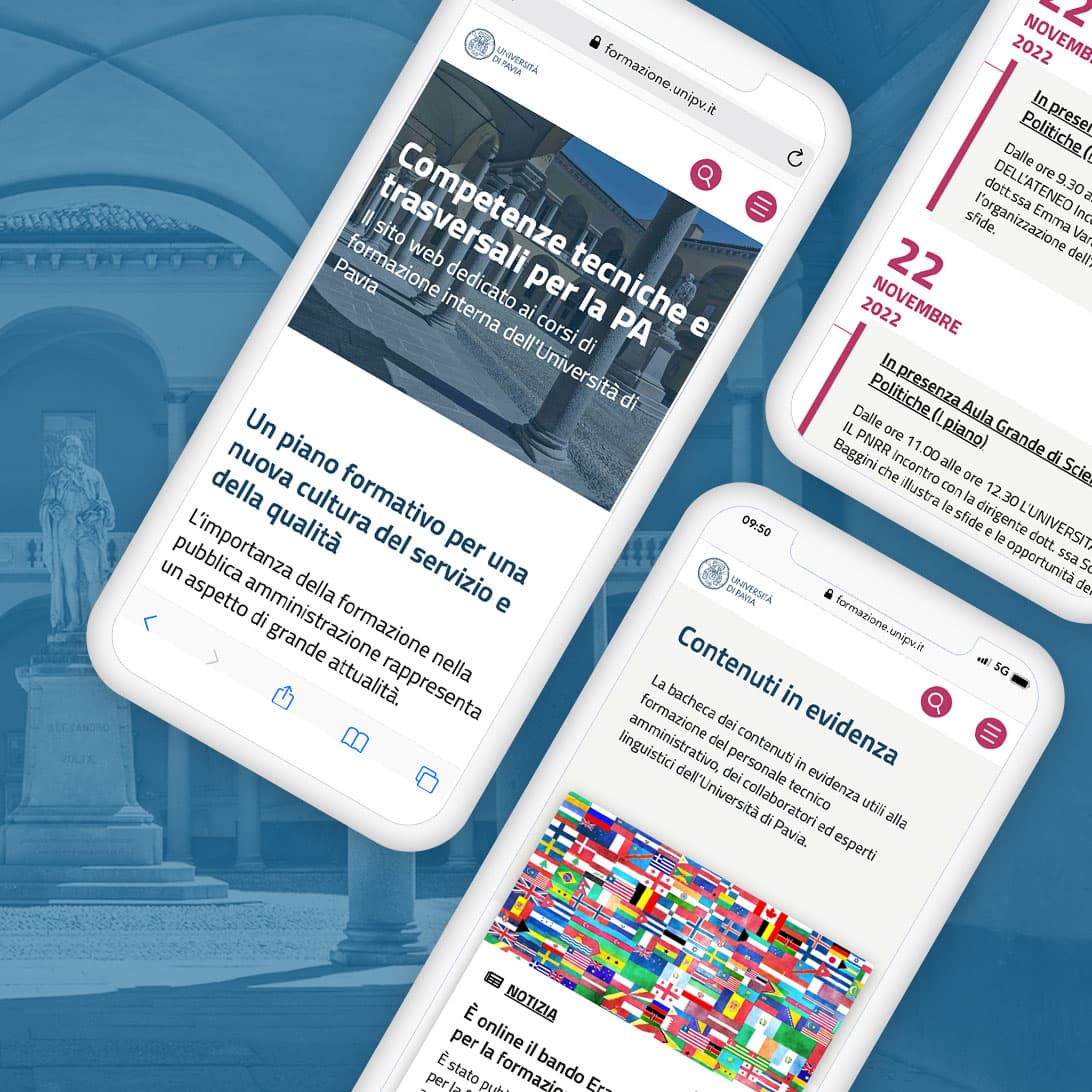
Today formazione.unipv.it is run entirely by the staff of the University of Pavia.
That is the result that counts more than any other. A well-built public portal is not one the agency has to keep alive, it is one the organisation manages to use on its own. The page builder, the training of the editorial team and a content model designed around the real work are there for that.